This morning, Multnomah County’s Board of Commissioners received a briefing on their long-awaited Economic Landscape Analysis, a $100,000 report commissioned last spring to help the county figure out its role in economic development. Chair Vega Pederson and Commissioner Brim-Edwards hired consultants to interview stakeholders, benchmark peer counties, and come back with recommendations.
The consultants were diplomatic. They summarized what they heard from stakeholders by saying the regional economic system is “fragmented, not broken” (slide 6).
I’d encourage you to read the actual data in their presentation and decide for yourself.
Lots of Partners, But No Leader
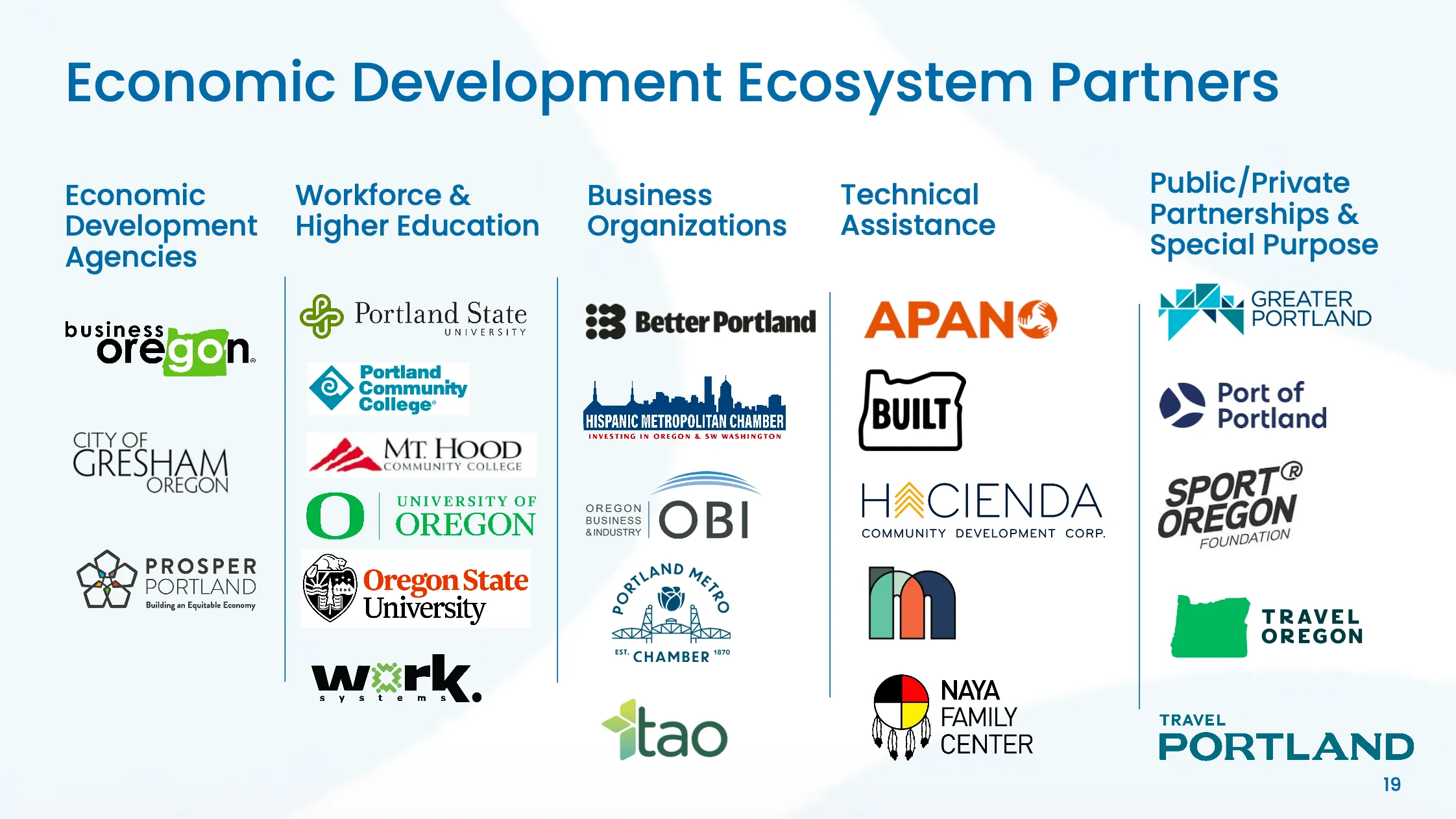
The report maps out the “Economic Development Ecosystem Partners” operating in this region (slide 19). There are nearly 30 of them — government agencies, chambers, universities, workforce boards, nonprofits. That’s not inherently a problem; a healthy regional economy should have a deep bench of institutions. The problem is that nobody sits above them. There’s no single entity with the authority or mandate to set a regional economic strategy and hold the system accountable to it.
When business leaders were asked what this ecosystem felt like from the inside, the answer was blunt: “operational friction” (slide 7). Permitting takes too long. Tax compliance is a burden. Public safety bleeds into the business climate. One stakeholder asked the question most Portland taxpayers have been asking for years: “For the taxes that we are paying — are we getting a commensurate level of service to have a thriving community?”
Cross the County Line, Drop Your Tax Rate to Zero
The most damning slide lays out the regional geography of business taxation (slide 8) — the loophole we’ve been describing for months. A business can relocate within the same labor market, cross a county line, and eliminate its local business taxes entirely.
From the county’s own briefing:
| County | Personal Income | Local Biz Tax | Property |
|---|---|---|---|
| Multnomah | 14.4% | 4.6% | 1.10% |
| Washington | 11.4% | 0% | 0.93% |
| Clackamas | 11.4% | 0% | 0.91% |
| Clark | 0% | 0% | 0.86% |
We can’t compete when our jurisdictional boundaries mathematically incentivize businesses to hop to the suburbs while drawing from the exact same talent pool.
Dead Last Among Peers
Between 2019 and 2024, Multnomah County’s traded sector employment declined 6.8% — the worst performance among all the peer counties the consultants examined (slide 9). Compare that to Travis County (Austin) at +22.7%, or Denver at +24.8%.
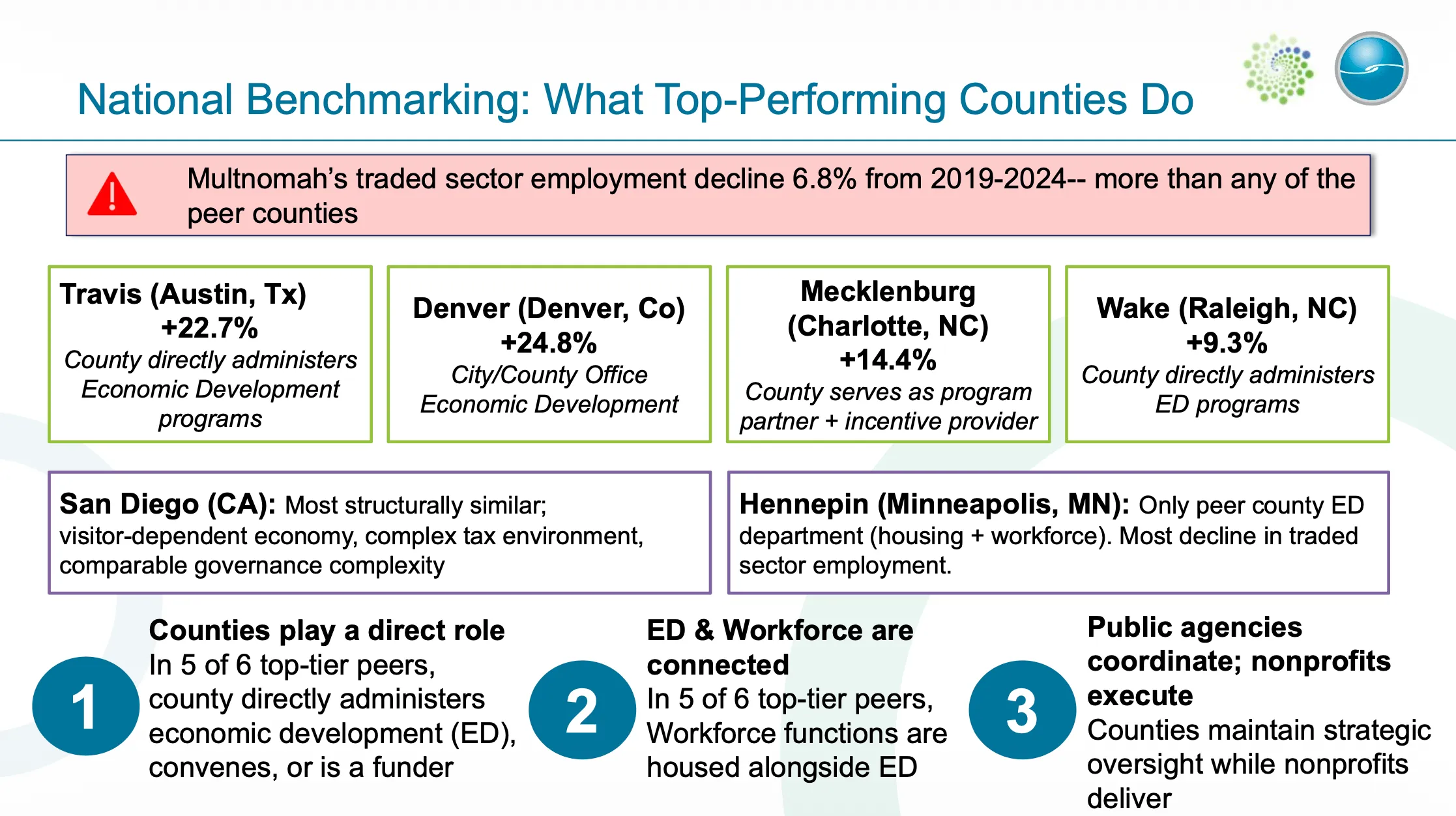
Here’s the detail that jumped off the page for me: in five of the six top-performing peer counties, the county government directly administers economic development programs. Denver — which operates as a consolidated city-county — saw the largest employment gains of any peer. The report’s own benchmarking data is a case study for consolidation.
More Coordination Won’t Fix a Structural Problem
The consultants recommend that the county act as a “coordinator” — convening partners, aligning fragmented systems, and bridging gaps between agencies (slide 10). Some of the specific recommendations are sensible. Framing livability investments as employer retention tools makes sense. Requiring placement outcomes as a condition of workforce funding is long overdue.
But the report includes its own rebuttal. Under the “Discipline” pillar, the consultants warn that “adding new initiatives without aligning existing ones risks compounding, not reducing, fragmentation.” Exactly right. And exactly why adding another coordination layer on top of a structurally fragmented system doesn’t address the root cause.
The county can’t coordinate its way out of a problem that exists because there are two separate governments trying to manage one economy.
The Real Solution Is Consolidation
To be fair to the consultants: they were hired to define the county’s role within the current structure, and they did that thoughtfully. Consolidation wasn’t in the Overton window when this report was commissioned last spring, and even if it had been, you can’t exactly recommend your client abolish itself. They were dealt a losing hand, and they played it well.
But when your region’s ecosystem requires a wall of logos to describe, when businesses are fleeing across county lines to escape taxes, when your traded sector employment is declining faster than any peer, and when the recommended solution is to coordinate a system that everyone acknowledges is fragmented — the structure is the problem.
A consolidated city-county government wouldn’t need to “convene, align, and bridge” across jurisdictional boundaries. It would be the jurisdiction. One government, one economic development strategy, one point of accountability for results.